3D tiles
Outdoor ceramic tiles in the public realm always fascinated me, especially if they are in relief. They seem to be such a good solution for buildings, street furniture and walls. There is an almost endless scope of design options; texture, pattern, light reflection, colour ..etc. The slide show shows examples from Belgium (Ostend), Portugal (Cascais) & France (Le Tréport).
If any reader knows of other fine examples, please let me know. I would like to collect more images and hopefully I can post a more comprehensive collection of examples in the near future.
Back to nature
 I have seen this type of benches before in forests and parks without really appreciating them. But the concept of a bench with a cast structure that mimics root wood, as disturbing as it looks, starts to grow on me. If you choose casting as a technique you can also open up to other shape typologies, no reason to keep the geometric language you pretty much have to respect if you fabricate something in any other standard way.
To then paint it in such a colour makes the bench almost eccentric, even if it goes against the initial idea of making the bench blend into its natural surroundings.
I also wondered if Maarten Baas came here on holiday one day…
Decluttering
Each day our cities seem to get more cluttered with new types of street furniture and equipment that didn’t exist only a few years ago. These new elements include endless amounts of operational electrical and telecommunication boxes that sprung up as these providers have been privatised and now operate without coordination. Additionally we also see an increase in free magazines dispensers, wi-fi masts, bike hire schemes, advertising and signage …etc that are implemented by different operators. Finally, the first digital advertising screens for city centers are threatening to be creeping-up in a city near you.
This creates a messy cocktail of visual pollution that damages the perception of our cities and we think it is important that cities have an organised and coordinated approach of how to handle the visual implications to our shared public space. The level of clutter should be contained and kept to the required minimum but, as many amenities remain necessary, there is also scope to regroup these into clusters and find new solutions of how they can be brought together or integrated into existing elements.
We have produced some first thoughts on this topic based on a specific urban context but to find a holistic approach requires an in depth consultation between all stakeholders (city officials, road engineers, private companies, urban planners and designers) to work out a strategy that is easy to apply to different urban situations without costing over the odds. In some situations this would result in new designs but the overall aim should be to regroup existing elements or to find inventive solutions that don’t require new structures.

- Urban amenities cluster
Picnic in Armenia
A friend of mine sent me this amazing picture of a picnic area in the woods near lake Sevan in Armenia. The first reflex of a local authority would be to paint these structures in a camouflage green / grey to blend in. I find this choice of colour stunning and beautiful, the contrast of the cyan blue in the wood highlights both nature and man-made structures, producing a surreal fairytale ambiance.
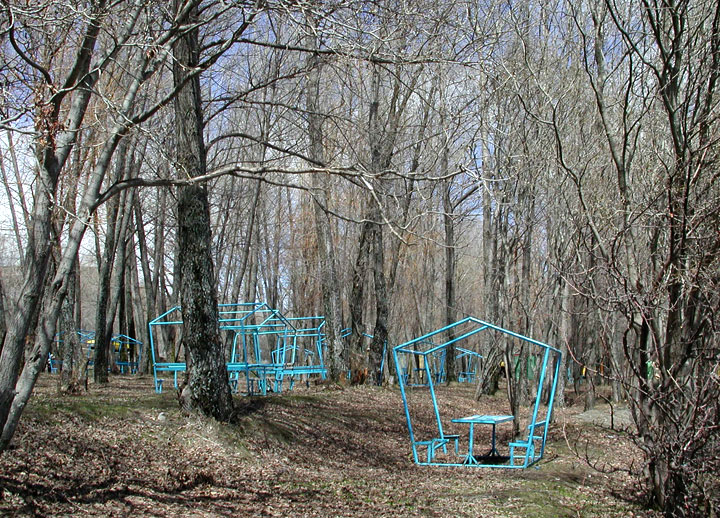 Photo © Sandrine Scheller
Guerilla graphics
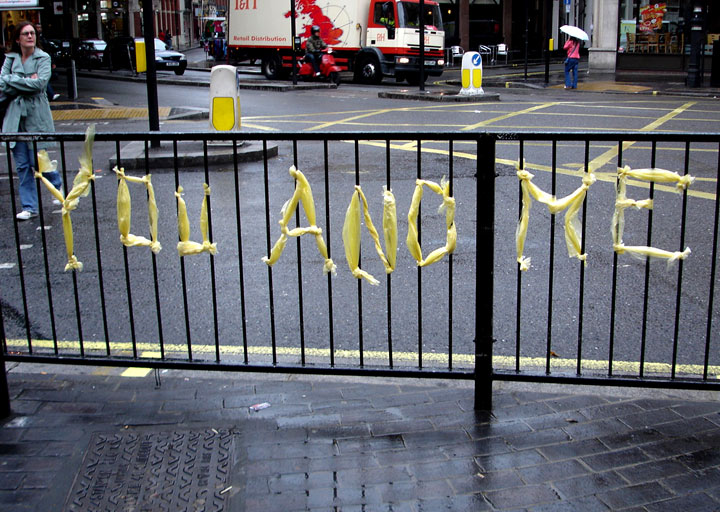
A very fine example of a public declaration of love, without vandalism…
I’m wondering if I shouldn’t start collecting this type of urban love messages. But surely someone has already published a book on this?
No design sign
When you walk around city centres you have to wonder if we need all that signage and graphic design. Often too slick, too loud and too perfect, over-designed corporate identities and graphics take away the human side of things. Maybe there are too many designers around that need to find work (and not enough courageous businesses).

Canary Wharf map texture
Applying a texture to the surface of street furniture is not only enhancing the visual quality (by adding intricacy, light and shadow), it also helps damages and scratches to ‘disappear’ and makes fly-posting very difficult. This need for texture in street furniture is usually solved by applying a straightforward pattern with no particular meaning or context but in this great example of a lamp post from Canary Wharf in London, the designers have used a simplified map of the very area where they are implemented as the basis of the pattern.

- Street furniture texture
Flower power
To counter the slightly grim baskets of geraniums in our towncenters the City of Luxembourg has asked Georges Zigrand Design Consultancy to come up with some ideas of how to bring flowers to their city in an alternative way and without adding clutter at ground level. Using the existing lamp post, just like the traditional baskets, this proposal would see rings of flowers and grasses creating a much larger floral area hovering above street level.
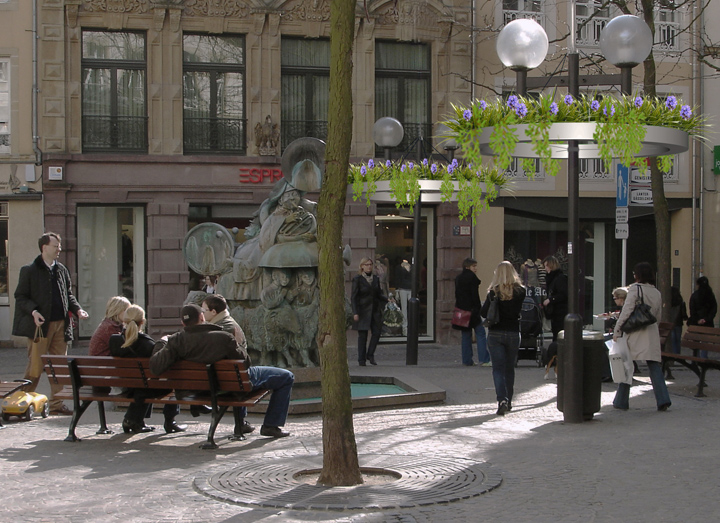
Designed by integratedplace © 2010
‘Atlantique’ streched deckchair for public parks
A piece of furniture I’ve designed many years ago and still think it is an interesting take on the conventional deck chair for public use. I could see this new version well in a park or a managed public environment. Everybody who has had a nap in the deck chairs for rent in London’s Hyde Park knows it’s a winner. The ‘Atlantique’ has been on show in the group exhibition ‘Global Edit’ at the 2007 Salone Internazionale del Mobile in Milan organised by the magazine Wallpaper.
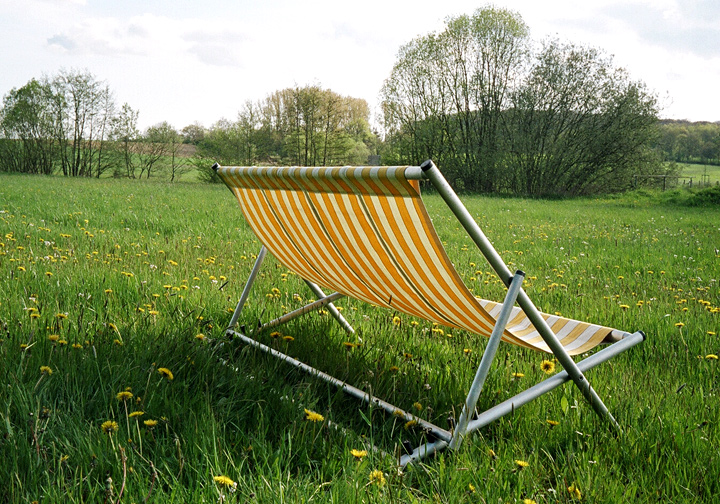
- Atlantique deck chair bench designed by Georges Zigrand
 Georges Zigrand Design Consultancy
leave a comment